Showing posts with label Heritage Breed. Show all posts

Saturday, April 9, 2022

First Lambs born, Ewes and a good LGD

 Lambing has finally begun. Cara Mia was the first to lamb the year this week. As usual with our ewes, her lambs arrival were a surprise. We had checked all the girls the night before. Nobody was showing signs of being close to lambing. 

  • Bagging up  
  • Teats firming
  • Vulva slackens
  • Vulva area pinks
  • Mucus discharge
  • Slightly swollen
  • Hollowing near the hips
  • Thinner / Not as wide
  • Stops Eating or Ignores Food
  • Nesting and Pawing the ground
  • Separating from the Flock

We went out to do morning chores and found her with her two lambs. 


This is the ewe lamb Cara lambed. 


Below is Cara's little ram lamb 


They are both doing very well. Cara is a a good mom and very protective of her lambs. Anastaycia, (our one LGD) kept trying to lick and sniff the lambs. Cara would have no parts of it. She has stomped and chuffed letting Anastaycia know the lambs are off limits. Which has resulted in Anastaycia staying a bit back from them but keeping an eye on Cara and her lambs. 

The lambs have snuck off several times to investigate Anastaycia. The lambs even got her to copy their little hop jump they have been doing. Last night Cara apparently was convinced Anastaycia was safe. Cara allowed the lambs to curl up with Anastaycia during the night. 
. 

Tuesday, March 15, 2022

Shetland Sheep

Shetlands are a primitive breed. The rams usually weight in about 110 lbs. and the ewes are about 85 lbs. Some may be lighter or heavier. They have their own personalities. Shetlands can be charmers. Especially when they want treats. We have a flock of cookie monsters. It is the easiest way for us to train them to come. 

They are intelligent and can learn how things work quickly. We have a few that learned how to open the gates to let themselves free range. Yes I woke up one morning to my ewes on the front lawn munching on the grass that was growing there. We have learned to keep the gated padlocked to contain some of the smarter sheep. 

We are waiting on the arrival of this year's lambs. We have hopefully managed to get the ewes bred this year.   Ava,  Cara, Heather, Ezri, Gerty, Sanga, Chetta and Sapphire are our current ewes. That is 8 ewes we are hoping produce for us this year. 

We have several new ewes that were bred a bit later than we normally like, but that could not be helped. Chetta, Sanga, Ava, Cara and Sapphire are our newest girls. We have no idea what we will have with these ladies. They were all bred to our ram Wrangler. 

As we only have one ram we are limited with our breeding program. We do plan to add a ram or two. We may even keep one of the ram lambs we produce this year to breed with the newer girls. I am hoping to get a Black or Dark Grey ram to add bit more color to our flock. 

We will see what we manage to produce this year. Will the lambs be all rams, mostly rams, all ewes, mostly ewes or will it be an even split? We won't know until the ewes lamb. That could be any day now or they may hold out for another month. You never know with these ladies.


Thursday, February 24, 2022

Pilgrim Geese


Before we went with Pilgrim Geese we had raised American Buff Geese. Other goose breeds we had considered raising were Cotton Patch, Shetland, Pomeranian, and Roman. We search for Cotton Patch and Shetlands and never found any breeders that responded to our inquiries on purchasing hatching eggs or goslings from them. 

Pomeranians and Roman while were much easier to purchase were knocked to the lower end of the list when I found Pilgrims available near me. We may in the future look at adding a second goose breed. Pomeranians are a good possibility as well as Shetlands, Romans and Cotton Patch. For now I will discuss Pilgrim Geese. 

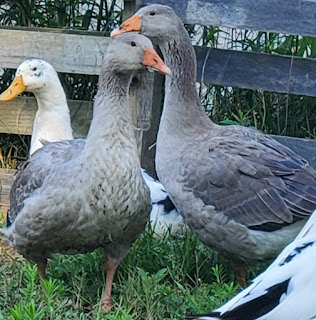
I have found Pilgrim Geese to be calm, quiet and pretty docile (unless it is breeding season some males can get protective). The are good foragers which means they don't need much commercial feed. Pilgrim Geese are listed as threatened with the Livestock Conservancy. They lay 35 to 45 large white eggs a year. The main use of this breed of goose is for meat. They reach market weight of 10 to 12 lbs. in about 10 to 15 weeks. These are a excellent medium weight goose for the backyard flock. 


They are excellent parents. Rearing their young without human intervention. They are sexually dimorphic you can sex the gosling from a visual inspection. Males at hatch are yellow/silvery with light colored bills. Females are grayish with darker colored bills. Adult males (called ganders) are mostly white with blue eyes, orange bills and legs. Females (called geese) are grey with dark brown eyes, orange bills and legs. 

The proper ratio of males to females for reproduction purposes is 1 male to 3 to 5 females. Breeder should be selected for a sweet temperament, full plump bodies, a smooth keel-less breast, an average length neck, broad back. Breeders should not have long necks, shallow breasts, long legs, a knob (usually from crossbreeding) or wrong feather coloring. .

Dave Holderread is the premier expert on waterfowl. He wrote a book on geese breeds that can be found here The Book of Geese: A Complete Guide to Raising the Home Flock. Hen House Publications. is the title of the book in case it is not available through amazon. He also wrote a breed specific bulletin available on his website. 

http://holderreadfarm.com/literature_page/literature.htm

Holderread no longer raises waterfowl. I am at this time not sure if you can still get his books or other publications. 


Saturday, February 20, 2021

American Mulefoot Hogs

 A few weeks ago we went and picked up a trio of  Registered American Mulefoot Hogs for the farm. We are hoping to breed the new ones come June which will set us up for October farrowings. 


Both of the gilts are checking out the bucket. 


Our young boar is a sweet boy who loves to get treats. 


4 days of winter rain has made a muddy mess


Back at the feeders


We have had hogs in the past. We have raise American Guinea hogs and Mangalitsa hogs. AGH just did not provide enough meat for us. Mangs had no registry in the US when we had them.


Our mulefoots are registered. We know by getting registered stock that they are what we say they are. We are hoping for our first litters to be born in the Winter of 2022.